Image Credit: London Halal Forum 2026
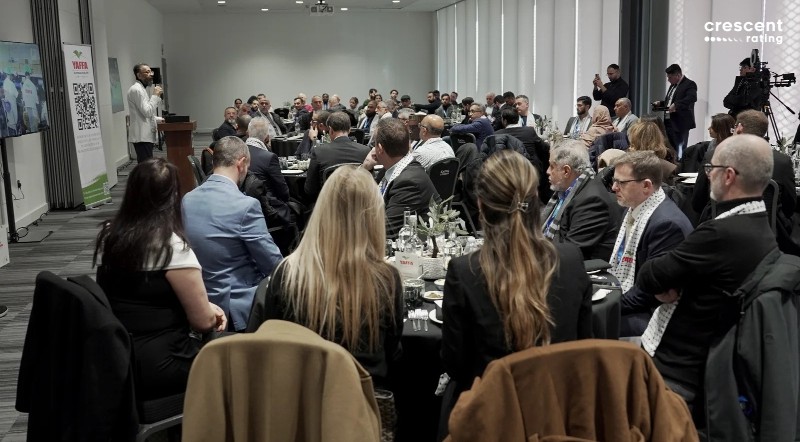
Held from 10 to 11 October 2026 in the United Kingdom, the London Halal Forum 2026 brought together international business leaders, destination marketers, trade commissioners, and industry pioneers as Europe continues to solidify its role as a key region for faith-conscious travel.
Representing the definitive global authority on faith-conscious travel intelligence, Fazal Bahardeen, Founder & CEO of CrescentRating and HalalTrip, participated as a featured panel speaker. Taking the stage in the high-profile session titled: “The Halal Traveler Economy: From Demand Signals to Destination Value.”
Moderated by Sidra Iqbal (Senior TV Presenter and Journalist at AAJ News Pakistan), the panel also featured Dr. Melih Şükrü Ecertaş (Independent Board Member at Turkish Airlines), Hafsa Gaher (CEO of Halal Travel Network), and Mudathir Adesanya (MD & CEO of IFING Media Limited).
Together, the speakers unpacked why faith-based travel is no longer a peripheral niche, how destinations should build credible visitor experiences, and how data and transparency turn traveler intentions into actual bookings.
About London Halal Forum 2026
The London Halal Forum serves as a cross-border bridge connecting the global Islamic economy with Western commerce, investment, and lifestyle sectors.
Over the two-day summit on 10-11 October 2026, the forum convened enterprise executives, policy advisors, and supply chain leaders to explore the multi-trillion-dollar Halal marketplace:
Cross-border trade dynamics, supply chain integrity, and governance across Halal consumer goods.
The expanding footprint of faith-compatible lifestyle services, gastronomy, and hospitality.
Consumer trust frameworks, digital visibility, and values-aligned branding in non-OIC environments.
With destinations across Europe actively seeking resilient visitor segments, the forum served as an essential platform to align commercial readiness with traveler expectations.
The 18-Year Evolution: From Awareness to the Destination Activation Stack
At the panel discussion, the moderator asked the panel travelers a question about how Muslim travelers are perceived by the wider industry, and whether destinations view these travelers as “difficult” or high-maintenance. Fazal then walked the audience through the 18-year journey of CrescentRating since its founding in 2008:
1. Creating Awareness (2008)
In the early years, the travel industry barely recognized Muslim travel as a distinct category. CrescentRating started by formulating the foundational Faith-Based Needs Framework, breaking down misperceptions and explaining core traveler requirements to destinations worldwide.
2. Benchmarking with the ACES Model (2015)
As awareness spread, CrescentRating partnered with Mastercard to launch the Global Muslim Travel Index (GMTI), introducing the ACES model to assess destinations across Access, Communication, Environment, and Services pillars.
3. Elevating Experience with RIDA (2022–2024)
With basic infrastructure established in many parts of the world, CrescentRating introduced the RIDA Framework—measuring how destinations deliver Responsible, Immersive, Digital, and Assured travel experiences.
4. The TRUST Layer & Destination Activation Stack (2025–2026)
Because consumer trust determines whether a traveler books or abandons a cart, CrescentRating introduced the TRUST layer (Transparency, Relevance, User Experience, Social Connection, Thoughtful Rewards). Bringing all three together, CrescentRating unveiled the unified Destination Activation Stack to help destinations systematically build and develop their market readiness.
Addressing the misperception of Muslim travelers, Fazal stated plainly:
"Destinations have realized that you cannot afford to ignore this market. We see prayer facilities being built in railway stations in places you wouldn't have imagined 5 or 10 years ago. At the end of the day, destinations are not doing this purely out of goodwill—they are doing it for commercial yield. And that is fine, as long as they provide the services travelers need."
Non-Practicing vs. "Less Practicing": The Spectrum of Traveler Needs
During an exchange on how destinations can accommodate diverse preferences without causing friction, Fazal pointed out that Muslim travelers are not a monolith:
The Halal Food Baseline: Even among those who are "less practicing," Halal food remains non-negotiable. While some travelers might not actively look for an official certificate, they will still not compromise on seeking Halal food.
The Enabling Approach: CrescentRating’s approach has always been to encourage destinations to provide an array of services, allowing travelers to choose according to their lifestyle. Citing CrescentRating’s Inflight Prayer Calculator launched in 2012, Fazal noted that providing prayer times and Qibla direction aloft enables those who wish to observe their prayers to do so with dignity, without imposing on those who do not.
The Communication Gap: Non-OIC vs. Muslim-Majority Destinations
A standout observation shared by Fazal centered on destination marketing and narrative ownership:
CrescentRating monitors between 500 and 1,000 global media articles daily via its proprietary media intelligence dashboards to track narratives around Halal travel, Muslim consumer trends, and Islamophobia.
Surprisingly, the destinations communicating most proactively about Halal tourism in global media are non-Muslim destinations—including Hong Kong, Taiwan, Thailand, Japan, and South Korea.
With the notable exception of Malaysia, many Muslim-majority countries fail to actively market or communicate their faith-friendly infrastructure to the world because they mistakenly assume it is an obvious default that needs no explanation.
Segment Innovation: Unpacking the "PAINS" of Solo Muslim Women Travelers
Discussing the surge of the Muslim Women in Travel (MWIT) demographic—highlighting that Gen Z Muslim women are often the primary decision-makers for family vacations—Fazal addressed audience concerns regarding solo travel security.
Drawing from the 2nd edition of CrescentRating’s Muslim Women in Travel Report with Mastercard, Fazal detailed the PAINS framework, which outlines the top five considerations for female Muslim travelers:
P – Privacy: Private recreation, swimming, and wellness spaces.
A – Amenities: Access to prayer spaces, hygiene facilities, and modest lifestyle options.
I – Identity: Feeling comfortable and accepted in one’s religious and modest identity without discrimination.
N – Networking: Connecting with fellow travelers and local communities safely.
S – Safety: Verified destination security, well-lit transit, and trusted local operators.
Fazal noted that when safety and clear communication are assured, Muslim women can travel with confidence, as seen in the rising flows of female travelers to destinations like Japan, South Korea, and Uzbekistan.
Unlocking the European Opportunity with CrescentRating
CrescentRating’s presence at the London Halal Forum 2026 underscored that capturing the Muslim traveler economy requires moving past generic statements. By grounding destination strategies in empirical data, structured frameworks, and transparent communication, destinations can bridge the gap between initial intent and confirmed bookings, turning traveler demand into lasting economic value.