From Feed to Prompt: How Muslim Consumers Will Discover Brands in the AI Age
Ask an AI assistant where to stay in an unfamiliar city and where to eat with confidence, and the answer arrives in seconds—fluent, assured, and narrowed to a handful of hotels and restaurants. Some of those recommendations are sound. Others are simply wrong about halal assurance, delivered with the same confidence as the rest.
That confidence, and what sits behind it, is the subject of this article. The establishments left off the list have no idea they were invisible. The ones misrepresented have no idea they were misrepresented. This is the new reality of brand discovery, and much of the industry has yet to grasp what it means.
When we founded CrescentRating in 2008, there was no credible standard for Muslim-friendly travel anywhere in the world, so we built one. Today we face a similar moment: a new standard is urgently needed.
Discovery has moved through three eras. The fourth has begun.
Historically, Muslim consumers discovered brands through their communities, including mosques, markets, and recommendations from family and neighbors. Trust was personal and spread by word of mouth.
Word of mouth, local mosques, markets, and direct neighbor trust.
Television, radio, and print reaching millions instantly.
Influencers, global peer networks, TikTok, and Instagram scroll.
Conversational AI assistants delivering hyper-curated shortlists.
Mass media marked a pivotal shift from personal recommendations to broader brand exposure. Television, radio, and print enabled brands to reach millions at once, though trust was still built through other means. This era was followed by the rise of social media, which transformed brand discovery by focusing on influencers, community-generated content, and global peer recommendations.
Our research with Mastercard in 2025 captured the peak of the feed era. In Indonesia and Malaysia, we found that social media accounted for 40% of brand discovery in Indonesia, with word of mouth at 22.5%. Traditional media had dropped to single digits. Malaysia showed similar trends, with platforms like TikTok and Instagram serving as the main channels for brand discovery, especially among consumers under 40.
From Feed to Prompt
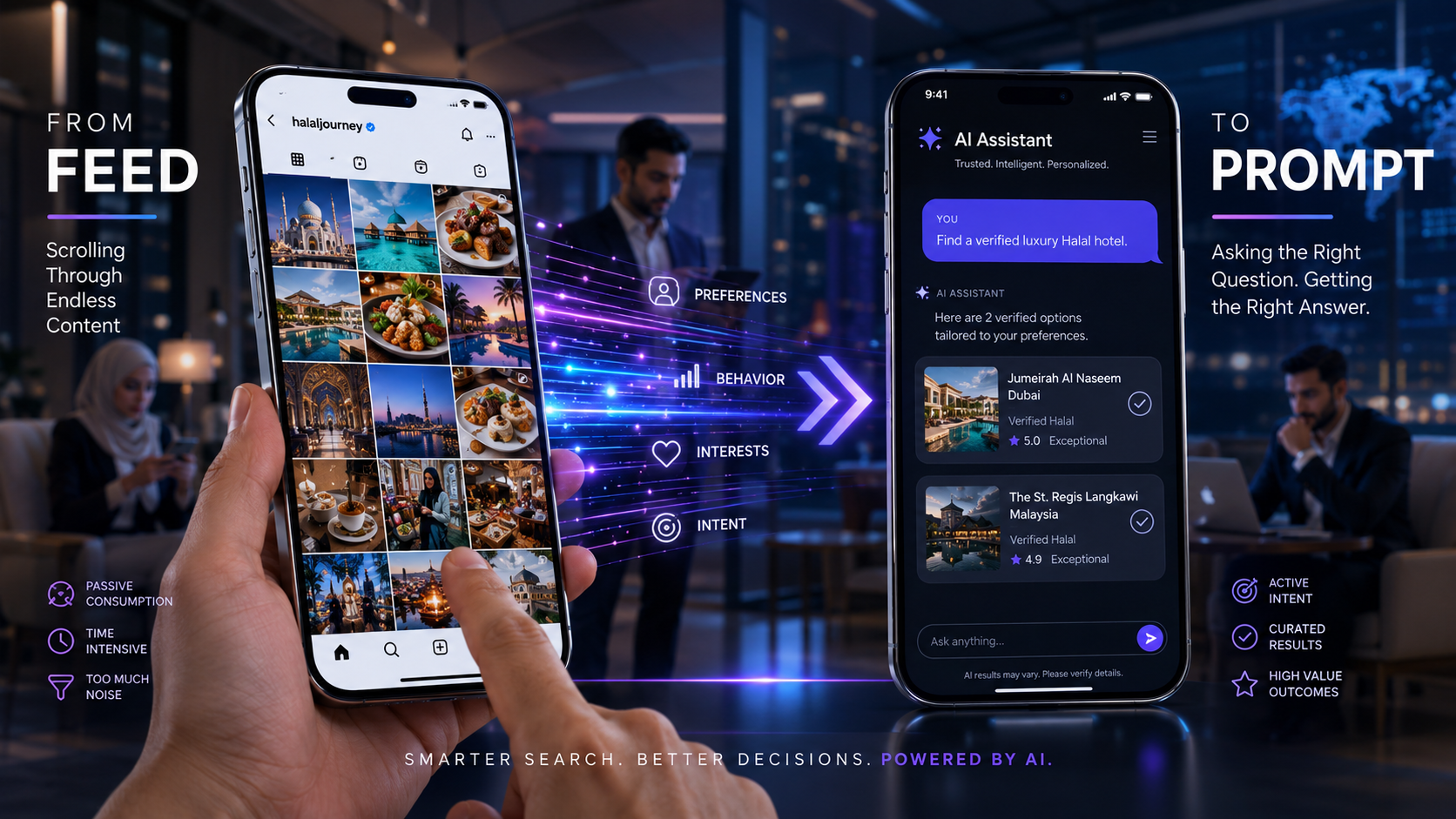
We now believe those reports marked the end of an era, not its future. The fourth era of discovery has begun, defined by conversation. Consumers are no longer just scrolling; they are asking questions. Increasingly, AI systems respond with a shortlist of only a few options.
The prompt era is already here.
This shift is occurring faster than any consumer trend we have tracked in 17 years. AI shopping is now integrated into platforms widely used in our markets, with e-commerce experiences embedded directly into AI conversations across Southeast Asia.
The two countries central to our 2025 research, which have some of the largest Muslim consumer populations globally, are experiencing this shift most rapidly. Consumers we previously surveyed about social media discovery are now asking AI assistants about halal products, suitable hotels, and brands that align with their values.
This era differs fundamentally from the previous three. In earlier eras, consumers reviewed many options before choosing. In the prompt era, AI systems make the selection before consumers see any options. The AI reviews available evidence, assesses trust and suitability, and presents a shortlist. The core idea is that visibility now determines whether a brand is considered at all.
The Halal Visibility Gap
The distance between how genuinely Muslim-friendly a brand is in the real world and how visible that evidence is to the AI systems now making recommendations.
The reality is that these two factors are often unrelated. A restaurant may maintain impeccable halal standards and serve its community for decades, but if this evidence is not published in a way AI systems can find and verify, it becomes invisible in the prompt era. Strong halal practice no longer guarantees discovery. Meanwhile, competitors with weaker credentials but clearer digital evidence are repeatedly recommended to travelers who may not know the difference.
For Muslim consumers, the stakes are higher than for most other segments. An incorrect AI recommendation for a running shoe results in disappointment, but a misstatement about halal assurance affects faith. We have already observed AI systems mistranslating halal certifications and providing incorrect answers to religious questions. In this context, trust is difficult to restore once lost.
The Evolution of the TRUST Framework
Our 2025 research identified the TRUST framework as central to what Muslim consumers expect from brands. While these principles remain entirely relevant in the age of AI, the audience interacting with them has fundamentally changed:
Transparency now requires evidence that machines can verify, not just statements for human readers. Relevance to faith now depends on whether an AI system can determine it accurately. The AI-Enabled Muslim Consumer still expects TRUST, but brands must now demonstrate it to algorithms first.
What should brands and destinations do now?
Some may argue this is premature, as AI recommendations currently represent a small share of decisions and the feed still dominates. The same was said about social media in 2010, and brands that delayed paid the price. Preparing early carries minimal cost, while being invisible when the shift is complete results in lost market share.
This is why we developed AIRA, our AI Recommendation Readiness Auditor. It assesses whether AI tools influencing Muslim consumer decisions can discover, trust, and confidently recommend an establishment, and identifies where recommendation confidence is gained or lost. AIRA is the first tool of its kind in this market and marks the start of our research agenda. In the coming months, we will publish the first systematic measurement of the Halal Visibility Gap across our industry, identifying which brands AI systems name, overlook, or misrepresent.
Building the Standard for the Next Horizon
In 2008, we began our work because faith-conscious travelers needed reliable information, and the industry needed a credible way to serve them. Eighteen years later, the question has evolved, but the core need remains. Today, travelers ask machines, and those machines require evidence.
Beyond travel, the broader halal economy—including food, fashion, and finance—will also be transformed by AI-driven discovery. Every brand in these sectors will face the same challenge. When the AI-Enabled Muslim Consumer inquires about your brand, what will the machine find?
That question marks the beginning of our current work. InshaAllah, we aim to answer it for the entire industry.
Ready to Benchmark Your AI Optimization?
Don't let your brand become invisible to algorithmic discovery models.
Get a Free AIRA Visibility Check →Explore Our Full Body of Work on AI Discovery →