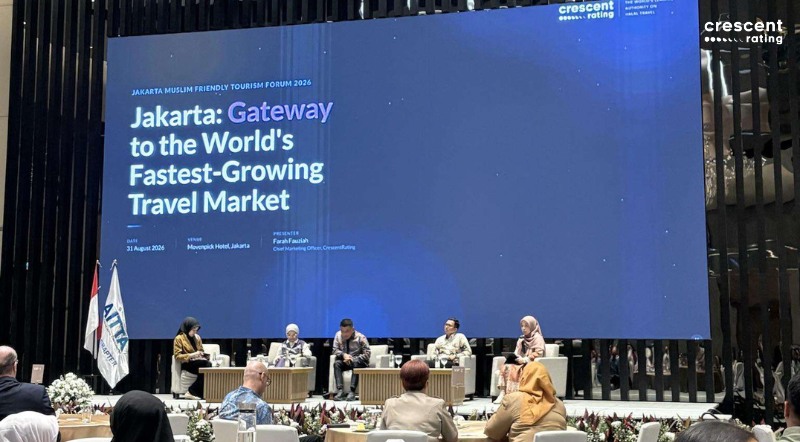

On 16 October 2026, the official results of the Indonesia Muslim Travel Index (IMTI) 2026 were unveiled at the Indonesia Sharia Economic Festival (ISEF) held at the Jakarta International Convention Center (JICC).
A joint publication developed by the Ministry of Tourism of the Republic of Indonesia, Bank Indonesia (BI), CrescentRating, and the Enhaii Halal Tourism Center (EHTC) – NHI Bandung Tourism Polytechnic, this fifth edition marks a vital milestone in evaluating and benchmarking provincial readiness to serve faith-conscious visitors across the archipelago.
What is IMTI and Why Has It Returned in 2026?
Indonesia’s tourism sector stands at a pivotal stage in its development. Supported by rich cultural heritage, diverse landscapes, and its position as the world's demographic center for Muslims, strategic planning and focused investments remain essential to sustain its leadership on the global stage.
In the Mastercard-CrescentRating Global Muslim Travel Index (GMTI) 2026, Indonesia climbed to joint 2nd place globally with its highest score to date (79)—achieving perfect scores of 100 in Prayer Spaces, Halal Dining, and Airport Facilities, and ranking 1st worldwide in Destination Marketing.
However, national performance relies on the strength of provincial execution. IMTI returns in 2026 to translate macro momentum into localized, actionable improvements. The 2026 edition expanded its analytical scope to 62 datasets (up from 60 in 2025 and 37 in 2018), evaluating 15 key provinces through the localized ACES framework: Access (10%), Communication (20%), Environment (30%), and Services (40%).
Key Findings of IMTI 2026
The 2026 report surfaces several structural developments defining provincial performance:
Overall Score Improvements Across Provinces
Across the assessed provinces, scores trended upward with an average increase of 4.8% among repeating destinations. The Services dimension registered the most widespread gains (averaging a 7% rise), followed by notable progress in Communication and Environment.
Disaster Management and Tourism Resilience
Situated on the Pacific Ring of Fire with roughly 127 active volcanoes, Indonesian destinations faced severe floods, seismic alerts, and wildfires throughout 2025–2026. The report emphasizes integrating risk forecasting, multilingual emergency communication, and hospital disaster preparedness—benchmarked by Nusa Tenggara Barat's emergency response frameworks and Japan's multilingual visitor safety models.
Maintaining Air Connectivity Amid Rising Costs
Aviation fuel (avtur) prices at Soekarno-Hatta surged by approximately 72% between baseline levels and April 2026, putting heavy upward pressure on domestic airfares. Because fuel comprises around 40% of airline operating costs, destinations face accessibility hurdles, underscoring the urgent need for multi-stakeholder collaboration to sustain viable route frequencies.
Developing Smart Tourism with AI & Digitalization
Capturing the global wave of "Tourism 5.0," the index tracks provincial AI adoption. Platforms like the Ministry of Tourism's virtual assistant MaiA, automated biometric immigration auto-gates, and localized AI chatbots are closing information fragmentation for travelers on the move.
Broader Expansion of Halal Facilities
Supported by BPJPH’s national SEHATI program—which provided 1.35 million free Halal certification quotas for micro and small enterprises (MSEs)—provinces expanded certified dining clusters (Zona KHAS) and upgraded public prayer amenities across transit nodes.
Global Trends Impacting the Indonesian Muslim Travel Market
The report identifies four macro shifts reshaping consumer choices globally:
-
Purpose-Led Journeys ("Whycation"): Travelers are moving from generic sightseeing to heritage-rich journeys where cultural immersion, community connection, and personal values guide the trip planning.
-
Digital & AI-Augmented Travel: Generative AI traffic to travel sites increased by 1,700% between mid-2024 and early 2025. Over 84% of travelers using AI report improved journey curation, making machine-readable destination data a baseline requirement.
-
Inclusive Travel for Every Generation: Elevating universal design for seniors, accessible tourism, and multi-generational families who seek combined faith-friendly provisions and barrier-free mobility.
-
Sustainable & Climate-Resilient Tourism: Demanding proactive conservation, environmental stewardship, and community-led preservation that protect natural assets against climate volatility.
Ranking Highlights: Jawa Barat Retains the #1 Position
Jawa Barat (West Java) has successfully retained the #1 overall ranking in IMTI 2026 with a score of 73.5, demonstrating exceptional execution in the Services and Communication pillars driven by its Smiling West Java Muslim-Friendly Tourism initiatives.
Meanwhile, Jawa Tengah (Central Java) made an impressive leap to 2nd place, securing the nation's best performance in the Services pillar. Nusa Tenggara Barat (NTB) rounded out the top tier in 3rd place, sweeping top national honors in both the Communication and Environment pillars.
Unlocking Indonesia's Next Tourism Chapter
IMTI 2026 is designed not merely as an annual scorecard, but as a strategic planning instrument for provincial governments, private investors, and destination managers. By identifying operational gaps and scaling proven regional practices, Indonesia continues to lay the groundwork to lead the USD 310 billion global Muslim travel economy.
Gain comprehensive data breakdowns, provincial scorecards, and tailored ACES recommendations by accessing the official Indonesia Muslim Travel Index (IMTI) 2026 Report here.