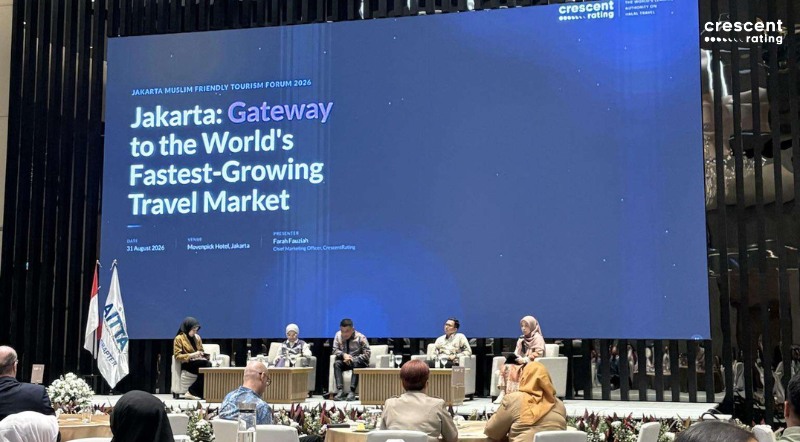
On 31 August 2026, senior government officials, provincial policymakers, travel agency executives, and hospitality leaders convened at the Mövenpick Hotel Jakarta for the Jakarta Muslim Friendly Forum (JMFF) 2026.
Representing the global authority on faith-conscious travel, Farah Fauziah Arditami, Chief Marketing Officer of CrescentRating and HalalTrip, attended as a keynote panel speaker. Delivering an actionable, Jakarta-tailored presentation titled “Jakarta as the Gateway to a Fast-Growing Travel Market,” Farah outlined how Indonesia’s primary urban metropolis can translate massive demographic advantages into international visitor yields.
About the Event: JMFF 2026
Organized by the Alliance of the Indonesian Tour & Travel Agencies (AITTA / DPD ASITA Jakarta Chapter) in collaboration with the Jakarta Provincial Government Tourism and Creative Economy Office (Disparekraf DKI Jakarta), JMFF 2026 convened over 200 key industry stakeholders.
Held under the banner theme “Building Jakarta as a World-Class Muslim-Friendly Destination” (Membangun Jakarta sebagai Destinasi Ramah Wisatawan Muslim Berkelas Dunia), the forum united leaders across aviation (Garuda Indonesia), hospitality (PHRI), and cultural institutions (TMII) to align policy, urban infrastructure, and commercial execution.
The Global Horizon & Indonesia’s Surge to #2
Farah opened the session by contextualizing Jakarta within global macro-travel data drawn from the Mastercard-CrescentRating Global Muslim Travel Index (GMTI) 2026:
-
Global Arrivals Trajectory: International Muslim arrivals reached 196 million in 2025 (+11.3% YoY) and are on track to scale to 262 million by 2030, driving an annual spend of USD 310 billion.
-
Demographic Scale: The global Muslim population is expanding toward 2.57 billion by 2036 (28.8% of humanity), with a median age of 25-27 years where 70% are digitally native consumers under 40.
-
Indonesia's Historic Momentum: In the GMTI 2026 rankings, Indonesia registered the strongest score surge (+3 points) across the leaderboard, climbing to share the #2 global spot alongside Saudi Arabia and Türkiye.
"Indonesia Doesn't Have to Win This Market": The Inherent Demographic Moat
A core thesis of the presentation challenged conventional destination thinking: Indonesia does not need to fight from scratch to "win" the Muslim travel market. Indonesia already possesses two structural advantages that no competing destination can replicate: a massive domestic core and an established regional inbound engine.
-
Domestic demand baseline: There are 216M Muslims in Indonesia, 87% of the total population, 63% of which are under 40 years old.
-
Source Market for Indonesia: In 2024, there were 227M Malaysian arrivals as Indonesia’s leading source market. Other source markets include Australia, Singapore, China, Timor Leste, and India.
-
Regional Concentration: 75% of inbound Muslim travel originates from ASEAN.
-
Muslim Demographic Center: Indonesia holds 11.3% of the world’s Muslims and is home to 86% of Southeast Asia’s Muslims population.
Why the Advantage Is Real, And Why the Window Is Now
While the numbers are staggering, an inherent demographic advantage does not automatically convert into economic capture.
The Muslim consumer cohort entering peak spending power between 2026 and 2036 grew up entirely on Instagram, TikTok, and AI search engines. A home market this large only converts if the destination is algorithm-ready, digitally discoverable, and seamlessly Muslim-friendly.
Policies designed for yesterday’s average visitor will miss tomorrow’s dominant traveler. The strategic window to shape physical infrastructure and curate digital discovery is open right now—before habits, loyalty corridors, and platform preferences calcify across this youthful demographic.
Jakarta’s Strategic Window & IMTI Performance
In the Indonesia Muslim Travel Index (IMTI) 2025, Jakarta distinguished itself as the best-connected city and ranked #1 as the most accessible province in Indonesia. Jakarta sits in an ideal position to capture extended traveler spend across four distinct strategic roles:
-
The Sovereign Gateway: International entry point anchored by Soekarno-Hatta International Airport's biometric auto-gates and expanding flight corridors.
-
A Premium Urban Destination: A cosmopolitan center blending modern luxury shopping and Halal gastronomy with deep Betawi and Islamic cultural heritage.
-
The MICE & Business Capital: A commercial powerhouse hosting corporate summits, Sharia financial forums, and international trade events.
-
The Regional Connector: The primary domestic springboard linking international arrivals onwards to leisure hubs like Bali, Lombok, and Yogyakarta.
From Basic Accommodation to Holistic Belonging
To capture modern traveler loyalty, Jakarta must shift from basic compliance to holistic belonging. This requires moving past manual checklists into AI Discoverability and deploying the RIDA Framework (Responsible, Immersive, Digital, Assured). When international Muslim travelers search for experiences, AI recommendation platforms must instantly surface verified prayer spaces, certified culinary options, and privacy-conscious wellness facilities across Jakarta.
5 Areas to Improve for Jakarta
To transform this vision into reality, Farah presented five immediate, actionable priorities for Jakarta's tourism stakeholders:
-
Formal Policy & Named Body: Establish a dedicated Muslim-Friendly Tourism Coordination and create a taskforce within Disparekraf to align multi-agency execution.
-
Machine-Readable Visitor Guide: Transition from static PDFs to a structured, API-ready and digital database crawlable by LLMs and travel AI agents.
-
Segment-Specific Design: Tailor experiences for key demographics, starting with women.
-
Front-Line Certification: Train and certify hotel and tour staff first, then assemble bookable Packaging and guaranteed faith-compatible urban itineraries for OTAs.
-
The "Start Here" Positioning: Market Jakarta as the necessary, culturally-rich first chapter of any Indonesian holiday, rather than a mere transit stop.
Unlocking Jakarta’s Full Potential
Indonesia has the demographic scale, the regional connectivity, and the cultural authenticity. By formalizing policy coordination, structuring digital data for AI discovery, and curating inclusive urban experiences, the capital can unlock its full potential.
Let 2027 be the year Jakarta stops being a city Muslim travelers merely pass through, and becomes the city where the Indonesian journey begins.