


December 2021Halal food
Halal Food Lifestyle Indonesia 2021
How Muslim consumers in Indonesia dined out, ordered in and judged Halal assurance in 2021, from street food to delivery apps, with KNEKS.
Explore the report
In 2019, Singapore's Muslims spent an estimated SGD 700 million on Halal dining and delivery, and Muslim visitors spent SGD 300 million more. Published in March 2021, the report surveyed 500 Muslim consumers between December 2020 and January 2021 on what they eat, how they find and order food, and which Halal assurance they trust. It reads the market through five drivers: trade, taste, technology, trust and tourism.
SGD 700M
spent by local Muslims on Halal dining and delivery in Singapore in 2019, CrescentRating estimated.
Halal Food Lifestyle Singapore 2021, p. 15
SGD 1B
for the whole Halal dining market in 2019, with SGD 300 million spent by Muslim visitors.
Halal Food Lifestyle Singapore 2021, p. 15
Close to 3,000
eating establishments were certified Halal by MUIS in 2019, 16.0% of them in hawker centers.
Halal Food Lifestyle Singapore 2021, p. 17
88.5%
of respondents found out about new Halal food through social media.
Halal Food Lifestyle Singapore 2021, p. 30
49.0%
used food delivery services at least once a week.
Halal Food Lifestyle Singapore 2021, p. 31
53.6%
never ate at places that display a ‘No Pork No Lard’ sign, and a further 23.3% rarely did.
Halal Food Lifestyle Singapore 2021, p. 35
CrescentRating's model put local Muslim spending on Halal dining and delivery at SGD 700 million in 2019, and the whole Halal dining market at SGD 1 billion once Muslim visitors are counted. COVID-19 disrupted the market in 2020.
Halal Food Lifestyle Singapore 2021, p. 15
| Generation | SGD a year |
|---|---|
| Millennials (aged 25 to 40) | 1,177 |
| Gen X (aged 41 to 55) | 1,214 |
| Gen Z | 791 |
| Boomers | 607 |
| Gen Alpha | 437 |
CrescentRating's model, alongside its 2019 market estimate. Halal Food Lifestyle Singapore 2021, p. 15
Millennials made up 24.0% of the local Muslim population and Gen X around 19.0%. The report names millennials the key driving force behind the sector's growth.
p. 15
MUIS, the only Halal certification body in Singapore, certified close to 3,000 eating establishments in 2019. Halal certified restaurants grew at a compound annual rate of 9.4% from 2013.
p. 17
Singapore has more than 100 hawker centers with more than 6,000 cooked food stalls, and the report estimates that more than 15% of those stalls cater to Muslims. UNESCO listed the country's hawker culture as Intangible Cultural Heritage of Humanity in December 2020.
p. 22
The South East region had the highest concentration of Halal eateries, followed by North West and Central Singapore.
p. 17
60% of respondents had meals with a non-Muslim friend in a Halal restaurant at least once a month.
p. 15
The survey's 500 respondents were 77.5% female and 22.5% male; 43.6% were millennials and 32.2% Gen X. Halal Food Lifestyle Singapore 2021, p. 9, 10
The report's Halal dining framework. Trade and technology are largely external drivers, taste and trust are internal ones, and tourism is the accelerator that links the other four.
| Driver | Role | What it covers | Themes in the report |
|---|---|---|---|
| Trade | External driver | The link between service providers, organizations, governments and commerce. | Trade and commerce in the Halal food ecosystem; the influence of non-Halal food industries on Halal food. |
| Technology | External driver | Halal food distribution and communications, and industry disruption and transformation. | Technology as a present industry catalyst; the new frontier in food and technology integration. |
| Taste | Internal driver | Consumer palate, purchasing power and habits, brand power and lifestyle preferences. | The evolving tastes of Singapore consumers; familiar foods and rising cuisines. |
| Trust | Internal driver | Halal assurance, awareness and viable options. | Halal assurance and value creation; labeling, trust and alternatives. |
| Tourism | Accelerator | The spread of people, culture, ideas and influences. | The role of tourism and immigrants in the Halal food scene; challenges and synergies between Muslim-friendly travel and Halal food. |
Halal Food Lifestyle Singapore 2021, p. 12, 13
At least 65.0% of respondents agreed there is a wide variety of Halal food in Singapore, but many said it is concentrated in a few clusters, with too few Halal eateries in the West and the heartland areas.
Halal Food Lifestyle Singapore 2021, p. 16
| Cuisine | Respondents |
|---|---|
| Malay | 89.4% |
| Indian | 69.7% |
| Indonesian | 69.3% |
| Chinese | 64.4% |
Halal Food Lifestyle Singapore 2021, p. 18
| Cuisine | Respondents |
|---|---|
| Thai | 64.0% |
| American | 53.6% |
| Japanese | 49.5% |
| Korean | 48.1% |
Halal Food Lifestyle Singapore 2021, p. 19
| Cuisine | Respondents |
|---|---|
| French | 43.8% |
| Mexican | 40.8% |
| Greek | 40.6% |
| Spanish | 39.3% |
Halal Food Lifestyle Singapore 2021, p. 20
| Price | Respondents |
|---|---|
| SGD 5 or less | 6.3% |
| SGD 6 to 10 | 55.3% |
| SGD 11 to 20 | 23.9% |
| SGD 21 to 30 | 6.7% |
| SGD 31 to 40 | 1.8% |
| SGD 41 to 50 | 2.4% |
| More than SGD 50 | 3.6% |
Halal Food Lifestyle Singapore 2021, p. 27
| Attribute | Rating out of 4 |
|---|---|
| Price | 3.9 |
| Authenticity | 3.8 |
| Meets dietary needs (allergies, vegan diet) | 3.6 |
| Nutrition level | 3.6 |
Halal Food Lifestyle Singapore 2021, p. 27
The report gives four reasons for the gap in non-Asian cuisines: too few chefs who know the Halal substitutes for some ingredients, substitutes that cost too much, the difficulty of replacing alcohol and other non-Halal ingredients while keeping the original taste, and too little demand for some cuisines.
p. 20
Most respondents would pay SGD 6 to SGD 10 for a meal, across income brackets and demographics. Nutrition counted for more among respondents over 45.
p. 27
More than 36.0% ate fast food at least once a week and 87.0% at least once a month. McDonald's led top-of-mind brand awareness, followed by KFC and Burger King.
p. 21
More than 85% of Muslim visitors to Singapore came from Indonesia, Malaysia, India and Bangladesh. The destinations Singaporeans traveled to most were Malaysia, Indonesia, Thailand, China, Hong Kong, Australia, Japan, Taiwan, Vietnam and South Korea. The report names these, with Singapore's ethnic mix and media such as K-Pop and Mukbang eating shows, as drivers of what local Muslims eat.
p. 19, 42
Social media, food blogs and word of mouth were how respondents found new Halal food, and delivery became more important during COVID-19 as eateries worked under safety rules.
Halal Food Lifestyle Singapore 2021, p. 30, 31
| Source | Respondents |
|---|---|
| Social media | 88.5% |
| Food blogs | 62.5% |
| Word of mouth | 53.7% |
| Lifestyle or travel blogs | 30.2% |
| News, online or printed | 21.4% |
| Newsletters | 4.7% |
Halal Food Lifestyle Singapore 2021, p. 30
| Service | Respondents |
|---|---|
| Grab | 84.2% |
| Foodpanda | 62.4% |
| McDonald's | 38.6% |
| Pizza Hut | 22.8% |
| Domino's Pizza | 16.0% |
Halal Food Lifestyle Singapore 2021, p. 31
| Frequency | Respondents |
|---|---|
| Daily | 3.8% |
| 3 to 4 times a week | 19.5% |
| Once a week | 26.1% |
| 1 to 2 times a month | 33.0% |
| Other | 17.6% |
Halal Food Lifestyle Singapore 2021, p. 31
Delivery apps let users filter for Halal food only, and the delivery process keeps Halal food in separate compartments.
p. 31
Home-based food businesses struggled to scale: less than 5.0% of respondents bought from them at least once a week, 27.0% once or twice a month, and almost a quarter never had. Respondents cited inconvenient collection, little engagement from sellers online, doubts about food quality and Halal assurance, and high prices including delivery fees.
p. 32
Respondents showed three levels of trust in the Halal assurance practices they meet. A ‘No Pork No Lard’ sign is easier to put up, but certification and rating build more trust and a stronger brand with Muslim consumers.
Halal Food Lifestyle Singapore 2021, p. 38
| Assurance level | Practices consumers read this way |
|---|---|
| Strong | Halal certification, Muslim-friendly rating, Halal Arabic logo, Halal minimalist symbol, the descriptor ‘Ingredients suitable for Muslims’ |
| Reasonable | Muslim seller, Muslim brand, Muslim country of origin, general seafood or vegetarian dishes, safe ingredient codes, inference of no alcohol, pork or cross-contamination |
| Doubtful | ‘No Pork No Lard’ signs, images of mosques, Middle Eastern artifacts and Muslim faces and names, pseudo-Arabic font alphabets |
Halal Food Lifestyle Singapore 2021, p. 38
| Answer | Respondents |
|---|---|
| Never | 53.6% |
| Rarely | 23.3% |
| Sometimes | 16.8% |
| Very often | 3.4% |
| Always | 2.9% |
Halal Food Lifestyle Singapore 2021, p. 35
| Sentiment | Respondents |
|---|---|
| Negative | 67% |
| Neutral | 25% |
| Positive | 8% |
Halal Food Lifestyle Singapore 2021, p. 36
Three groups of factors decide whether Muslims eat at a ‘No Pork No Lard’ place: awareness of Halal food and the availability of clearer Halal options; brand assurance, meaning a Halal logo and trust in the producer; and cross-contamination, meaning whether the meat's status can be confirmed and whether alcohol is present.
p. 37
MUIS names two newer challenges for Halal integrity: cloud kitchens, where vendors may share preparation and storage areas, and virtual brands, which appear only online while a Halal certificate is tied to physical premises.
p. 40
“Any establishment that has a plan to dive into the Halal market should equip itself with a good understanding of the market.”
“Consumers have relied much more on digital content to find out the latest products and search for competitive prices.”
“For owners who want to reach out to the Muslim market, sincerity alone is not enough.”
December 2021Halal food
How Muslim consumers in Indonesia dined out, ordered in and judged Halal assurance in 2021, from street food to delivery apps, with KNEKS.
Explore the report
October 2026IMTI
How ready Indonesia's provinces are to welcome Muslim travelers: all 15 provinces ranked on the ACES framework, with every pillar score, the best performers and the full report.
Explore the report
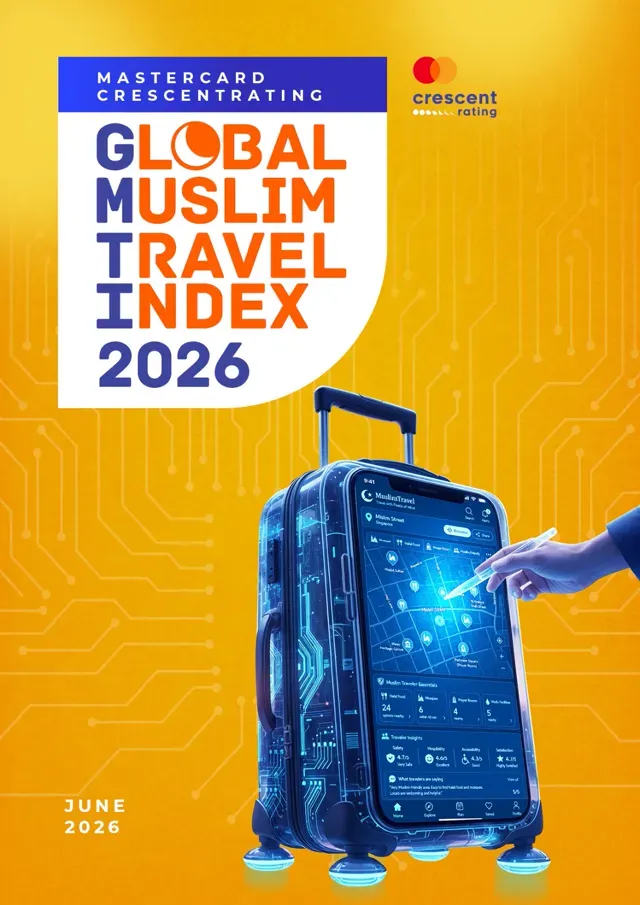
June 2026GMTI
The benchmark of Muslim-friendly travel: 150 destinations ranked on Access, Communication, Environment and Services, with the full rankings, destination profiles and the report.
Explore the report
Mastercard-CrescentRating, Halal Food Lifestyle Singapore 2021
For interviews, data requests or research built around your destination or brand, our research team can help.