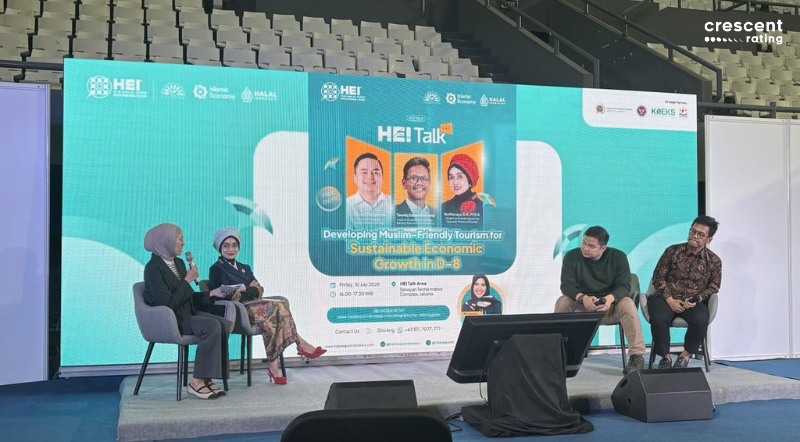
The convergence of value-driven travel, next-generation technology, and demographic expansion has elevated the global Halal tourism sector into a powerhouse of macroeconomic growth. At the high-profile D-8 Halal Expo Indonesia held on July 10, 2026, international stakeholders, policymakers, and corporate executives gathered for a dedicated forum session: “Developing Muslim-Friendly Tourism for Sustainable Economic Growth in D-8.”
Representing CrescentRating, Tawfiq Ikhtianto joined the panel to present authoritative market insights alongside Dennis Depriade, Director of Business Acquisition at Artotel Group and Nia Niscaya, Tourism and Creative Economy Specialist at the Ministry of Tourism. Together, the panellists mapped out the future of cross-border trade, sustainable ecosystem design, and regional GDP diversification across the Developing Eight (D-8) member nations.
Key Discussion Pillars: Benchmark Data and Strategic Positioning
The panel focused on equipping D-8 destinations with an objective roadmap to tap into a global travel corridor projected to reach 262 million international arrivals by 2030. The core presentation outlines focused on three strategic pillars:
-
Global Trends and Benchmark Data: Evaluating real-time operational performance and changing traveler sentiments in Muslim-Friendly Tourism (MFT).
-
Premium Market Capture: Identifying the precise booking filters required to position D-8 destinations effectively to capture high-yield, premium Muslim traveler segments.
-
Sustainable Infrastructure: Standardizing localized MFT metrics while actively building out community-based, resilient Halal tourism ecosystems that shield destinations from external macroeconomic shocks.
Navigating Demographic and Market Shifts
To win market share, the panellists argued that destinations must look past static travel tropes and adapt to three tectonic shifts reshaping global travel architecture:
1. The Youth Dividend and Age Dynamics
The modern consumer engine is overwhelmingly young, with approximately 70% of the global Muslim population under the age of 40. As true digital natives, this cohort delegates complex travel filtering directly to agentic AI assistants and large language models (LLMs). Capturing this block requires transitioning away from analog travel packages toward mobile-first, cashless, and digitized discovery setups.
2. The Shift to "Home-Continent" Mobility
Heightened regional proximity risks, fuel price volatility, and airspace realities have altered flight behaviors. Rather than canceling itineraries entirely, modern travelers are heavily prioritizing predictable, cost-efficient, and short-haul regional travel corridors. This has positioned South-Eastern Asia as a leading operational hub for inbound stability.
3. The Structural De-Concentration of Travel Flows
The market has experienced a profound diversification of source demand. In 2019, the top 30 outbound markets controlled an overwhelming 88% of concentrated market share. By 2026, that footprint has de-concentrated to 77%, proving that outbound expenditure and travel demand are becoming broader, globally distributed, and heavily influenced by emerging diaspora communities.
A Shared Framework: Standardizing Muslim-Friendly Tourism
To eliminate leakages along the travel timeline, the panellists emphasized the critical need for a unified operational framework across all member states. Fragmented standards cause friction for international arrivals.
By standardizing metrics using the quantitative ACES Framework—which systematically benchmarks over 60 datasets across Access, Communication, Environment, and Services—D-8 destinations can accurately isolate where their ecosystems capture share and where physical adjustments are required.
Strategic Roadmap: Six Core Actions for D-8 Destinations
To effectively translate these insights into sustainable, long-term GDP growth, the panel outlined six critical action items for regional tourism operators and state bodies:
-
Dismantle Access Barriers via E-Visas: Accelerate the digitalization of border procedures and promote regional visa facilitation to attract high-frequency, short-haul regional arrivals.
-
Optimize for Algorithmic Visibility: Ensure that certified dining options, prayer facilities, and hospitality locations are structured into machine-readable data architecture so they are natively suggested by next-generation AI travel agents.
-
Institutionalize Mandatory Halal Training: Deliver cross-sector education programs for local entrepreneurs and frontline staff to broaden cultural proficiency and secure traveler trust.
-
Expand Premium Maritime and Airport Gateways: Upgrade wudu (ablution) installations, high-quality prayer rooms, and faith-sensitive amenities directly inside primary transit terminals.
-
Nurture Grassroots Community Ecosystems: Partner directly with local craft industries, traditional networks, and independent regional businesses to design values-driven and sustainable heritage tourism packages.
-
Harmonize Inter-Regional Data Tracking: Connect regional analytics with trackers like the Muslim Travel Intent Tracker (MTIT) to actively anticipate shifting forward-looking intent and manage fluid corridors mid-cycle.
The Future-Proof Blueprint
The takeaway from the D-8 Halal Expo Indonesia 2026 is clear: capturing premium global travel yield is no longer about isolated marketing budgets, but it is about unified structural execution. By anchoring multi-year tourism strategies in standardized data frameworks, expanding algorithmic visibility, and protecting universal traveler values, the D-8 block can confidently future-proof its visitor economy against volatility and unlock unparalleled economic expansion.