
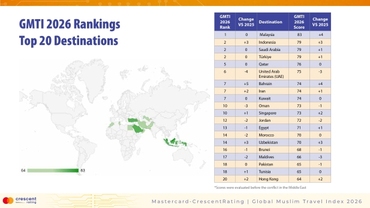
As the global visitor economy adapts to changing traveler behaviors and evolving safety expectations, the criteria for selecting a destination have expanded far beyond simple hospitality markers. The Mastercard-CrescentRating Global Muslim Travel Index (GMTI) 2026 provides a rigorous evaluation of 150 destinations worldwide, highlighting that true market leadership belongs to those that can systematically eliminate cross-border friction while providing uncompromised personal dignity on the ground.
For destinations targeting a projected USD 310 billion spend pool by 2030, building a resilient inbound strategy requires matching physical preparedness with transparent data trust.
The ACES Framework
To determine final score placement on the global leaderboard, the index leverages the multi-dimensional ACES model, an objective data architecture that measures destination readiness across four non-negotiable core pillars:
-
Access: Evaluating ease of entry, cross-border flight connectivity, visa processing efficiency, and transport infrastructure.
-
Communication: Measuring how effectively a destination interacts with the market, structures digital outreach, and educates local hospitality stakeholders.
-
Environment: Examining overall social safety, carbon emissions management, universal design accessibility, and the complete absence of faith-based restrictions.
-
Services: Analyzing the range, availability, and quality of core on-ground amenities such as certified dining and verified prayer spaces.
While all four pillars dictate global competitiveness, this final destination showcases zeroes in on the dual pillars driving physical mobility and structural on-ground comfort: Access and Environment.
Access Framework: Gateways and Cross-Border Corridors
The Access criteria (weighted at 10% of the overall index) evaluate how easily and smoothly a traveler can enter and move through a destination from the top outbound engines. This tracks visa policies, direct air route frequencies, and transit node quality.
Strategic Access Performance Leaders
United Arab Emirates (UAE)
Retains its number-one global position as the world's premier accessible gateway. This lock on the leaderboard is sustained by the UAE's superior air and land connectivity networks, world-class airport facilities, highly efficient public transit integration, and seamless cross-border visa policies.
Qatar
Holds steady in second place globally. Qatar's rank is driven by exceptional transport infrastructure and its established history of managing massive multi-generation flows for major international events. Simplified digital visa processes and expanded transit capacity ensure minimal congestion.
Oman
Sustains its third-place standing on the index. Oman's strong performance is anchored by a highly robust land transport sector specifically engineered to smooth regional transit within the GCC, combined with welcoming entry requirements and continuous facility upgrades.
Saudi Arabia
Climbed aggressively to fourth place. Fueled by its Vision 2030 tourism strategy, the Kingdom has rapidly scaled up access through substantial investments in national airlines and high-speed rail networks, backed by a unified e-visa system that allows regular tourists to perform Umrah seamlessly.
Access Summary & Market Highlights
Visa facilitation continues to function as a major catalyst for destination choice. Destinations that simplify documentation, reduce processing times, and deploy transparent online setups are better positioned to attract international visitors. Outbound demand is heavily supported by progressive digital expansions, such as the JAPAN eVISA system, which eliminates embassy visits and streamlines border entries for short-term tourism.
Environment Framework: Social Safety and Inclusive Spaces
The Environment pillar (weighted at 30% of the overall index) evaluates multiple facets of a destination's social climate, public utilities, and underlying baseline conditions to determine its overall suitability.
Strategic Environment Performance Leaders
Kuwait & Bahrain
The two countries anchor the absolute highest tiers in the environment standings. These destinations secure top marks by delivering an uncompromising environment regarding faith restrictions—explicitly confirming that travelers face zero limitations, discrimination, or public bans regarding the hijab, niqab, or ritual slaughter practices.
Malaysia & Türkiye
Both destinations share top-tier positions as major cultural and spiritual anchors. Their rankings are driven by robust historical Muslim visitor arrivals, deep-rooted multicultural integration, and public spaces that inherently align with the values, comfort, and peace of mind of the faith-conscious traveler.
Singapore
Operating as a primary non-OIC environment benchmark, Singapore maintains an elite standing globally. Singapore secures its high rank by dominating the basic utilities and universal design categories, combining exceptional public safety metrics and low crime records with highly reliable sanitation, internet connectivity, and inclusive transit networks.
Environment Summary & Market Highlights
Reflecting a highly positive global shift, the index's average score for general safety improved beautifully from 75 to 79. This upward trend highlights successful cross-border efforts to minimize hate speech, counter Islamophobia, and establish welcoming environments where families and solo travelers can explore with high confidence.
Driven by a global push toward universal design, the index's average score for accessible travel rose to 61, demonstrating robust structural investments to eliminate physical and cognitive barriers for differently-abled guests.
The Accessibility and Environment Safety of 150 Countries
In today's highly competitive travel landscape, global destination success depends entirely on executing a balance between data trust, low-friction entry pathways, and absolute social inclusivity. Discover where all 150 destinations ranked, map your destination's baseline against regional peers, and explore complete market analytics.
Download the Full Mastercard-CrescentRating Global Muslim Travel Index 2026 Report Here.