
Indonesia’s tourism sector stands at a defining stage in its development. As the world’s demographic heart for the Islamic faith, the country possesses a unique advantage: a massive domestic market, cultural diversity, and Islamic heritage across thousands of islands.
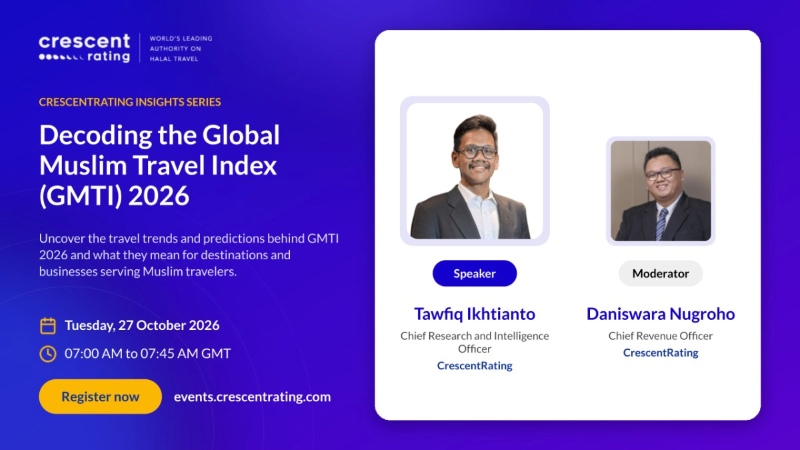
On the global stage, this advantage has translated into notable leadership. In the Mastercard-CrescentRating Global Muslim Travel Index (GMTI) 2026, Indonesia secured joint 2nd place worldwide with an all-time high score of 79—earning perfect scores of 100 in Prayer Spaces, Halal Dining, and Airport Facilities, while claiming 1st place globally in Destination Marketing.
However, sustaining long-term competitiveness requires turning national momentum into localized strength. As detailed in the Indonesia Muslim Travel Index (IMTI) 2026—collaboratively published by the Ministry of Tourism, Bank Indonesia, CrescentRating, and EHTC - NHI Bandung Tourism Polytechnic—Indonesia’s journey is increasingly shaped by strategic planning, systemic disaster preparedness, and digital acceleration under Tourism 5.0.
Indonesia's Muslim Demographics
The foundation of Indonesia’s tourism ecosystem is powered by unparalleled demographic factor:
Sovereign Scale: Indonesia is home to approximately 250 million Muslims, representing 87% of the national population and 11.2% of the global Muslim community.
Regional Dominance: Within Asia, Indonesia represents 17% of the total Muslim population, while contributing 86% of ASEAN’s total Muslim population. Across the archipelago, 17 individual provinces boast a Muslim demographic exceeding 90%.
A Youthful Engine: More than 62.1% of Indonesia’s Muslim population is under the age of 40. This includes Gen Z at 25.51%, Millennials at 23.42%, and Gen Alpha at 20.43%.
This generational composition is fundamentally altering consumer demand. Young and digitally connected travelers actively prioritize authenticity, environmental stewardship, seamless technology, and purpose-led experiences over passive sightseeing.
Indonesia’s Growing Muslim Travel Market Opportunity
Indonesia’s international tourism has demonstrated a strong post-pandemic recovery. While total foreign visitor arrivals reached nearly 100% of pre-pandemic numbers in 2025, Muslim visitor arrivals tracked an equally sharp upward trajectory—rebounding from pandemic lows to approximately 2.3 million international Muslim visitors (accounting for 15% of all inbound arrivals to Indonesia). Key market dynamics include:
The ASEAN Source Market
Nearly 75% of Muslim inbound arrivals originate within ASEAN. Malaysia remains the largest source market, contributing over 1.44 million Muslim travelers in 2025 alone, bolstered by currency purchasing power and short-haul flight networks.
Untapped Potential
While Indonesia's share of global Muslim travelers previously touched 18%, the country’s strategic roadmaps aim to lift market penetration toward 20% by developing certified dining, upgrading airport transit, and expanding direct marketing to non-ASEAN and Middle Eastern markets.
Domestic Volume-Balancing Gateways
High domestic tourism volume (led by West Java with 21.2 million local visits, alongside East Java and Central Java) contrasts with international gateways like DKI Jakarta, Bali, and Lombok (NTB), demonstrating the dual need to cater to local inter-province travelers while enhancing global visibility.
Disaster Resilience in Tourism
Positioned along the Pacific Ring of Fire and home to approximately 127 active volcanoes, Indonesia’s tourism sector faces recurring natural hazard exposure. Between 2025 and 2026, severe floods in Sumatra, heightened seismic activity around Mount Anak Krakatau, and seasonal forest fires in Kalimantan directly disrupted visitor facilities and accessibility.
By July 2026 alone, the National Disaster Management Authority (BNPB) recorded 1,201 disaster events nationwide—dominated by hydrometeorological events like floods (525) and extreme weather (306).
To protect both travelers and local economies, destination management must integrate risk mitigation directly into tourism planning:
Standardized Risk Infrastructure: Upgrading physical evacuation routes, clear bilingual hazard signage, and pre-positioning emergency logistics (backup power and clean water) across coastal and mountain destinations.
Digital Warning Systems (Lessons from Japan): Drawing inspiration from initiatives like Japan’s multilingual “Safety Tips” mobile alert system and disaster-control visitor facilities (such as the Kamenose drainage tunnels), Indonesia has a clear blueprint to build centralized digital disaster monitoring tools that deliver real-time warnings directly to visitors’ devices.
Tourism 5.0, Digitalization, and AI
As traveler expectations shift toward frictionless mobility, digitalization and Artificial Intelligence (AI) are redefining the travel experience across Indonesia. Generative AI traffic to travel platforms surged by 1,700% globally, and 84% of AI users report that digital tools directly improve their travel journeys.
Indonesia is actively modernizing its tourism architecture to meet the expectations of digitally native travelers:
Pioneering Tourism AI with MaiA: The Ministry of Tourism launched MaiA, an AI-powered digital assistant designed to deliver personalized, 24/7 itinerary planning while serving as a verified data center directly backed by official government standards. MaiA mitigates information fragmentation by connecting travelers with verified Halal dining and prayer facility locations across destinations.
Transit Infrastructure: Major gateways like Jakarta’s Soekarno-Hatta International Airport have deployed automated biometric immigration auto-gates and expanded e-visa systems, cutting processing times for travelers.
SME & Digital Discoverability: With BPJPH providing 1.35 million free Halal certification quotas (SEHATI) for micro and small enterprises (MSEs), provincial destinations are integrating certified businesses (Zona KHAS) into central digital databases, ensuring AI travel algorithms can verify and surface local operators to incoming tourists.
Charting a Sustainable and Resilient Horizon
Indonesia’s Muslim-friendly tourism journey reflects a comprehensive transformation: moving from basic faith provisions to a data-driven, resilient, and inclusive visitor economy. By pairing demographic momentum with digital innovation, safety frameworks, and certified service standards, Indonesia is positioning its provinces not only to attract global Muslim travelers, but to set international standards for excellence.
Download the official Indonesia Muslim Travel Index (IMTI) 2026 Report to access detailed provincial scores, ACES frameworks, and strategic development playbooks here.