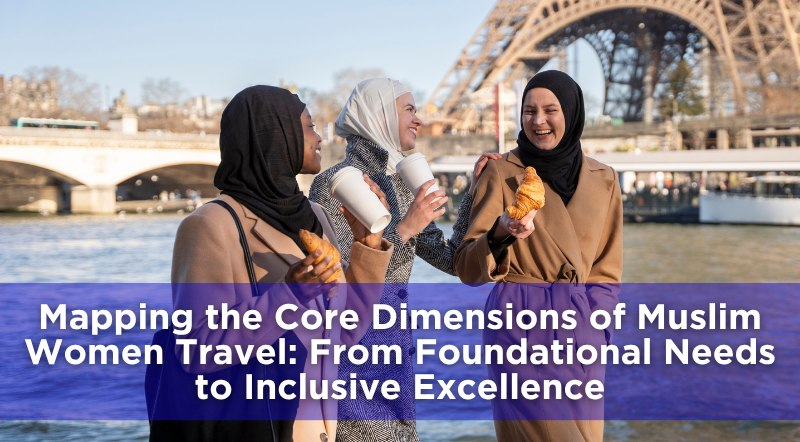
The global travel economy is witnessing a structural shift, propelled by the rapid maturation and rising autonomy of the Muslim women's travel segment. Representing an unshakeable market block, Muslim female travelers grew to 90 million globally in 2025, accounting for 48% of all international Muslim visitor arrivals. Moving far beyond spontaneous consumption, this segment curates their journeys with high intentionality, seeking out environments that seamlessly match their personal growth, physical safety, and faith requirements.
To help destinations and service providers translate consumer data into precise, operational capability, the Mastercard-CrescentRating Muslim Women in Travel (MWIT) 2026 report outlines the faith-based services needs. This layered roadmap details the transition from non-negotiable baselines to experiential differentiators.

Need to Have: Foundational Faith-Based Requirements

The "Need to Have" dimension represents the non-negotiable bedrock of the Muslim lifestyle travel market. If a destination or property fails to visibly secure these core elements, it is systematically excluded from the consumer's decision-making matrix during the research phase.
Verifiable Halal Food Infrastructure
The absolute presence of clear and identifiable Halal dining options stands as a fundamental prerequisite. While the market is expanding, travelers still report significant daily friction, noting that a localized lack of understanding regarding the depth of Halal rules often forces them to spend valuable time manually scanning ingredient list labels at convenience store checkouts.
Women-Appropriate Prayer Facilities
Baseline destination readiness demands the designation of clean, accessible, and dedicated prayer spaces. A persistent challenge voiced by travelers is that many public prayer rooms are not gender-segregated, with 80% of travelers highlighting their preference for separate female prayer rooms. This distinct lack of structural privacy can introduce high discomfort for Muslim women trying to fulfill their religious obligations.
Water-Friendly Washrooms
Incorporating universal design elements—such as installing bidets, hand sprays, and private wudu (ablution) areas specifically configured for women—remains a foundational amenity requirement across transit hubs and lodgings. Private areas are also a concern, with 87% of respondents mentioning the need for a private wudu area for women.
Psychological and Visible Safety
Foundational compliance extends beyond physical assets to encompass a secure, welcoming social climate. Destinations must actively demonstrate a visible culture of tolerance, ensuring environments are completely free from restrictive clothing bans, harassment, or the underlying anxieties associated with the rise of Islamophobia.
Good to Have: Enhancing Comfort and Connections
Once the structural foundations are confidently achieved, "Good to Have" elements come into play to enrich traveler satisfaction, alleviate operational logistics, and foster deep emotional connections with the host community.
Ramadan-Specific Hospitality Services
Traveling during holy windows requires proactive destination scheduling. Properties can drastically enhance comfort by offering structured Suhoor (pre-dawn meal) and Iftar (fast-breaking meal) arrangements directly via custom room service or tailored restaurant hours.
Values-Aligned Social and Eco-Causes
Modern Muslim women—especially the highly influential Gen Z and Millennial traveler profiles—increasingly seek out cultural engagement opportunities that align with their ethical and faith principles. This manifests in a strong desire to participate in community-based tourism, support hyper-local businesses, and favor environmentally sensitive tour operations.
Curated Muslim-Oriented Experiences
Incorporating dedicated Islamic heritage tours or female-centric history walks provides a vital sense of belonging, driving cultural understanding and long-term brand loyalty.
Nice to Have: Privacy and Lifestyle Enhancements
The pinnacle of the needs hierarchy is defined by luxury, sophisticated privacy, and custom lifestyle enhancements. Providers who successfully deliver these solutions position themselves to capture high-value premium spend.
Secluded, Women-Only Recreational Spaces
Privacy and modesty preferences remain central to relaxation. There is a rising demand for dedicated female-only spaces, with travelers preferring women-only beaches and prioritizing women-only hours at swimming pools, wellness spas, and beauty salons.
Exclusive Women-Designated Hotel Environments
Implementing women-only hotel floors and private, well-equipped fitness gyms allows female solo travelers and sisterhood groups to travel with absolute peace of mind and comfort.
Strictly Halal and Alcohol-Free Facilities
Premium lifestyle experiences are heavily magnified when faith-sensitive environments are thoughtfully preserved, with 76% of surveyed respondents stating a direct preference for hospitality facilities that completely avoid non-Halal services (such as attached gambling spaces, alcohol sales, or discotheques).
Driving Destination Action: The RIDA Framework in Practice

To systematically scale these insights and measure real-world performance, CrescentRating processes destination readiness through the precise, multi-dimensional lens of the RIDA Framework (Responsible, Immersive, Digital, and Assured):
Responsible: Promoting Sustainable and Ethical Tourism Practices
The Responsible dimension establishes the ethical foundation of tourism management. It focuses heavily on eliminating sociocultural biases by providing continuous cultural competency training for hospitality personnel regarding Muslim women's clothing requirements and faith practices. Furthermore, responsibility mandates the deployment of structured, transparent procedures to respond to Islamophobia-related complaints within active tourism zones.
Immersive: Creating Deep, Engaging Experiences
Tourism providers can optimize this pillar by collaborating with grass-roots local communities to offer secure and interactive home-stays, guided neighborhood walks, and heritage crafting workshops. By enforcing inclusive certification standards and providing transparent activity descriptions, destinations can ensure that experiences live up to the safety and cultural expectations of the traveler.
Digital: Leveraging Technology for Enhanced Accessibility
Leveraging technology to maximize accessibility and lower travel friction, destinations can implement inclusive digital labeling and standardized visible markers for Halal dining and women-designated facilities. Moreover, the integration of advanced, AI-trained agents allows travelers to seamlessly extract localized data on women-inclusive spaces, verified online Halal status, and nearby mosques, effectively reducing pre-arrival anxiety
Assured: Ensuring Reliability and Quality of Services
Moving away from makeshift, shared setups, this pillar requires gender-specific architectural engineering, such as separate female prayer rooms and private wudu facilities. By combining systemic zero-tolerance anti-discrimination policies with private, women-staffed wellness and hospitality zones, destinations can systematically elevate their readiness within the evolving Muslim travel ecosystem.
By actively implementing measurable variables across the RIDA Impact Rating (RIR) framework, global travel brands can step away from a generic "one-size-fits-all" approach. Addressing the distinct, nuanced needs of Muslim women travelers allows destinations to unlock massive commercial equity, foster genuine global inclusivity, and systematically convert casual inspiration into long-term, actionable market growth.
Download the full Muslim Women in Travel 2026 Report here to address Muslim women’s challenges in global travel.